Description
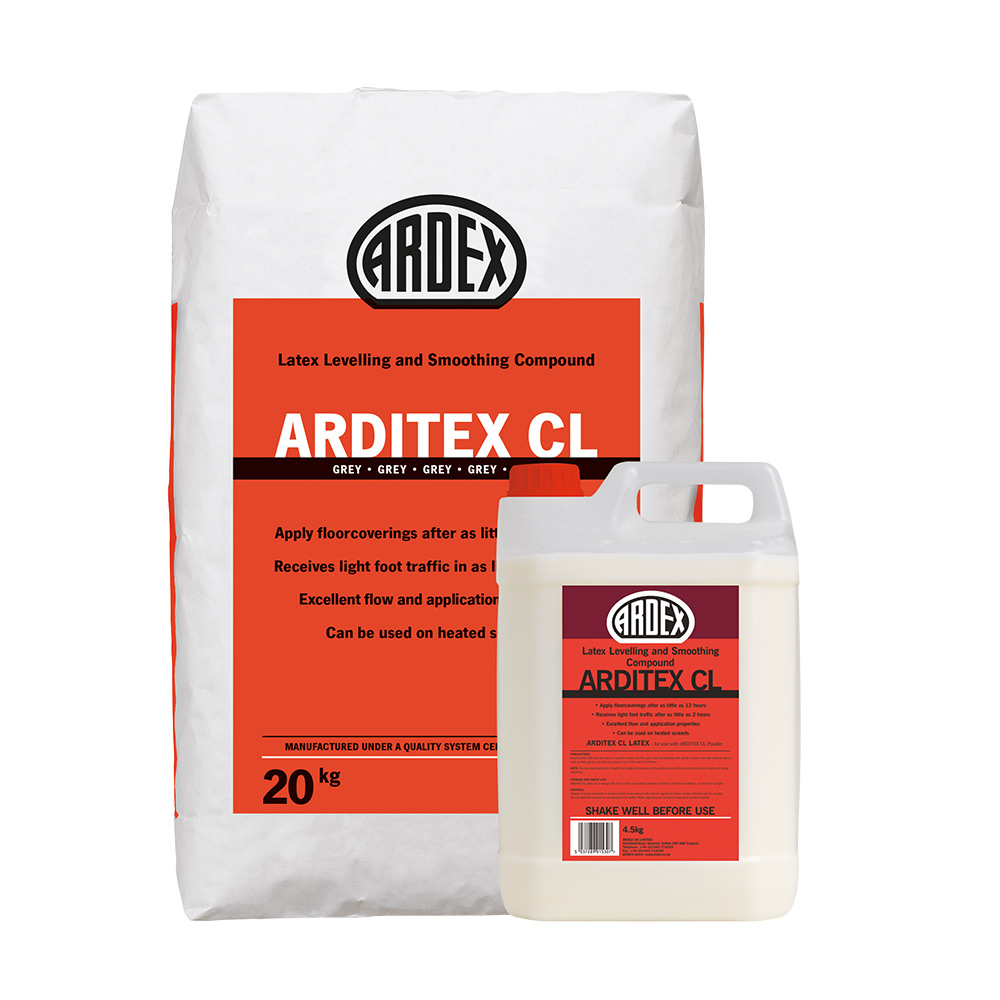
Arditex CL Latex Levelling Compound is a latex levelling and smoothing compound, with excellent flow and application properties. Arditex CL receives foot traffic after as little as 2 hours and most floorcoverings can be applied 12 hours after application.
Arditex CL Latex Levelling Compound is for smoothing and levelling most common internal subfloors such as concrete, cement/sand and Gypsum (anhydrite) screeds. It can be laid from a feathered edge to 10mm in a single application, or up to 30mm by incorporating Ardex Coarse Aggregate.
Arditex CL Latex Levelling Compound is supplied in two parts as a single unit, a 20kg bag of powder and a 4.5kg bottle of additive. The price above is for one unit.
Surface Preparation:
Prior to applying Ardex Arditex CL, the surface of the subfloor must be clean, sound and free from dust, plaster droppings, grease, paint, polish and any water-softenable or loosely adhered materials. Any remaining adhesive residues should be checked to ensure that they are not water-softenable, and that they are hard, sound and have sufficient cohesive strength to receive a levelling compound.
Priming:
All surfaces should be primed with the appropriate Ardex Primer. On highly porous or absorbent surfaces, such as concrete or cement /sand screeds, prime the surface with Ardex P51 Primer in accordance with the datasheet. The use of Ardex P51 Primer will aid application, improve coverage and reduce suction and pinholes. If the subfloor is impervious or very dense e.g. ceramic tiles, prime with Ardex P4 Rapid Drying Multi-Purpose Primer, in accordance with thedatasheet.
If mixes with a high aggregate content require smoothing or if a subsequent layer is required to the standard mix, the dried Ardex Arditex CL will require priming. Priming should be carried out with Ardex P51 diluted 1:3 with water, as for absorbent surfaces. The Ardex P51 must be applied by broom or brush and not with a roller and allowed to dry prior to applying the Ardex Arditex CL.
GYPSUM (Anhydrite) Screeds:
Ensure that the screed has been correctly applied, the surface has been suitably prepared using appropriate mechanised equipment and tested for moisture in accordance with the screed manufacturer’s recommendations. For guidance, the screed must contain less than 0.5% moisture using the carbide method, or give readings of less than 75% Relative Humidity when checked with a flooring hygrometer.
Gypsum based screeds can adversely react with cement containing materials such as levelling compounds, ceramic tile adhesives etc, unless suitably primed. The prepared surface of the gypsum screed must be sealed with an appropriate primer such as Ardex P51 diluted 1:3 with water or, dependent on the information from the gypsum screed manufacturer, a sand blinded epoxy primer such as Ardex R3E Primer may be required to ensure adhesion, and to prevent the cement containing materials coming into direct contact with the gypsum based screed.
NOTE: Ardex Arditex CL Levelling Compound is not suitable for use on asphalt or timber subfloors. Consult the Ardex Arditex NA Levelling Compound, or Ardex FA20 Levelling Compound datasheets, alternatively contact ARDEX Technical Support Team for more information.
Moisture Control:
Ardex Arditex CL Levelling Compound can be applied directly to Ardex MVS 95 Residual Moisture Vapour Suppressant within a 24 hour period if the applied Ardex MVS 95 has not become contaminated with site debris or foot traffic. If contamination occurs it should be removed and a subsequent application of Ardex MVS 95 applied. Consult the Ardex MVS 95 datasheet for further guidance.
When correctly primed Ardex Arditex CL can be applied to ARDEX Damp Proof Membranes. Please consult the Ardex DPM 1 C / Ardex DPM 1 C R datasheets for further information. In all cases Ardex Arditex CL must only be used up to a maximum thickness of 6mm.
Mixing:
The mix ratio is one 20kg bag of Ardex Arditex CL powder to 4.5kg of Ardex Arditex CL liquid. The latex liquid should be thoroughly shaken and poured into a clean mixing container. Add the powder gradually while continuously stirring. The use of an Ardex mixing paddle with a 10mm chuck electric drill makes light work of mixing. The mixed mortar has a working time of approximately 20 minutes at 20°C. For thicknesses above 10mm, and up to a maximum of 30mm, the incorporation of up to an equal volume of Ardex Coarse Aggregate is important and will prove economic.
Application:
Pour the mixed material onto the prepared and primed subfloor. Spread with a trowel or ARDEX Pin Leveller to the required thickness in one operation. Apply at temperatures above 5°C and rising. The use of a spiked roller will improve the surface finish and performance of the Ardex Arditex CL mortar while it is still wet and workable.
Applications over underfloor heating:
The cement/sand screed, concrete or calcium sulphate subfloor should be installed in accordance with BS 8204 Part 1. The underfloor heating system should be commissioned in accordance with the manufacturer’s instructions and in accordance with the guidance given in BS 8204 Part 1.
Once thermally cycled and commissioned, the underfloor heating should be turned down to 15°C before the application of the Ardex Arditex CL and the final floor covering. After 48 hours the under floor heating system should be gradually re-commissioned, in accordance with BS 8204 Part 1 and BS 8203 to avoid rapid thermal change and local variations in temperature.
Thickness:
Ardex Arditex CL Levelling Compound can be applied from a feathered edge up to 10mm in one application. To fully utilise its free flowing properties the product should be applied from 2mm. A minimum application of 3mm should be applied on an impervious subfloor where the floorcovering adhesive requires an absorbent layer.
Drying and hardening:
Under good conditions a 3mm layer of Ardex Arditex CL Levelling Compound is walkable after as little as 2 hours, and thin applications are ready to receive most floorcoverings after only 12 hours at 20°C. Setting, hardening and drying times will be extended at lower temperatures, and shortened at higher temperatures/humidity levels.
Thicker applications will require longer to dry. The optimum site conditions required in BS 8203: 2001 for flooring installations is a minimum of 18°C and a maximum of 27°C and should remain constant before, during and after application of flooring products.
Coverage:
Approximately 5m² per unit when applied as a typical smoothing application of between 2mm – 3mm.
Technical Data:
Bulk density of fresh mortar approx. 1.9Kg/litre.
Compressive Strength: Greater than 20N/mm² at 28 days.
Tensile Bedding Strength/Flexural Strength: Greater than 10N/mm² at 28 days.
Click here to view this product on the manufacturers website.


Reviews
There are no reviews yet